Pulp O2 Review: A Detailed Look at Pulp’s London Arena Show
Pulp’s return to London’s O2 Arena in June 2025 was more than a nostalgia trip. The Sheffield band used the two-night residency to celebrate their long-awaited album More, reconnect with longtime fans, and demonstrate that their distinctive mix of art-pop, storytelling and theatrical performance still worked on a huge arena stage. The shows took place on June 13 and 14, 2025, as part of the You Deserve More UK arena tour.
For anyone searching for a Pulp O2 review, the most important point is that the concerts balanced two different versions of the band. There was the Pulp associated with 1990s Britpop classics such as “Common People,” “Disco 2000” and “Babies,” but there was also the older, stranger and more theatrical group represented by More. Contemporary reviews highlighted how successfully those elements came together during the London shows.
Pulp’s Long-Awaited Return to London
Pulp’s relationship with the O2 was particularly significant because the concerts arrived during another major chapter in the band’s history. After a long recording break, Pulp returned with More, their first studio album in 24 years. The album reached No. 1 in the UK during the same weekend as the O2 concerts, giving the shows an unexpected celebratory dimension.
Frontman Jarvis Cocker acknowledged the occasion during the performances, even bringing attention to the album’s chart achievement. The timing made the concerts feel less like a simple reunion and more like the beginning of another phase for Pulp.
This was also important because the band’s appeal has never depended entirely on straightforward rock performance. Pulp’s music often combines social observation, humour, awkwardness, romance and theatrical storytelling. That personality translated surprisingly well to an arena as large as the O2.
The Atmosphere Inside the O2
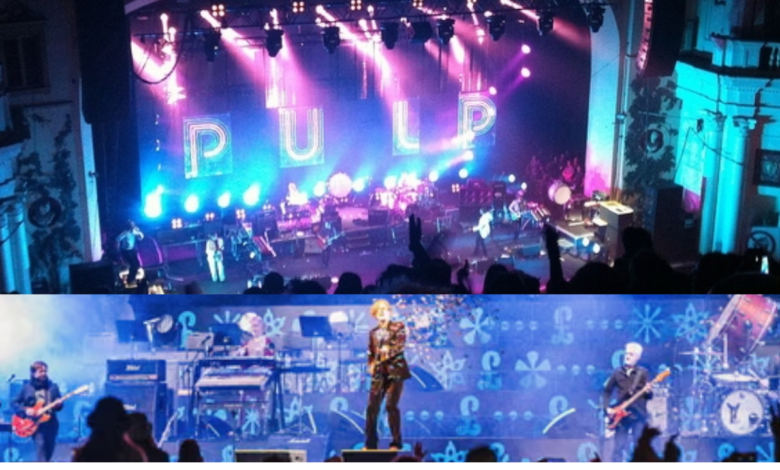
One of the strongest aspects of the show was its visual presentation. Reviews described an elaborate production featuring large screens, lasers, confetti, strings, backing singers and inflatable figures. The stage moved between different visual worlds rather than remaining a conventional concert setup.
The production reflected Pulp’s unusual personality. Instead of attempting to look like a contemporary stadium-rock act, the band leaned into theatricality and eccentricity. The presentation included references to Sheffield and the Limit nightclub, an important part of Cocker’s early musical life.
That attention to detail helped create a sense that the audience was being taken through different periods of Pulp’s history rather than simply watching a greatest-hits performance.
Jarvis Cocker Remained the Centre of Attention
Any serious Pulp O2 review has to discuss Jarvis Cocker because his stage presence remains fundamental to the band’s identity.
Cocker did not perform like a conventional frontman. His movements were exaggerated, angular and deliberately theatrical. He pointed, danced, leapt and interacted with the audience while maintaining the dry humour that has characterized his public persona for decades.
The Evening Standard particularly emphasized his informal interaction with the crowd, including his habit of carrying snacks and sharing them during the performance.
That kind of behaviour might seem strange in a major arena, but it is exactly what made the performance feel like Pulp rather than a generic reunion concert. Cocker’s personality remained central even when the production became enormous.
The New Songs From More
A major test for the tour was whether songs from More could stand alongside Pulp’s best-known material.
The evidence from the O2 performances suggests they could.
The set included “Spike Island,” “Grown Ups,” “Tina,” “Farmers Market” and “Got to Have Love,” among other material associated with the new album. NME reported that these newer songs sat naturally alongside the band’s older favourites.
“Spike Island” was particularly important because it opened the concert and immediately established the idea that this was not simply an exercise in looking backwards.
“Grown Ups” brought another perspective, reflecting on age and memory, while “Farmers Market” provided a more personal moment when Cocker dedicated the song to his wife during the London shows.
The new material therefore helped demonstrate how Pulp’s songwriting had changed without abandoning the band’s distinctive character.
The Classic Pulp Songs Still Delivered
Of course, the audience had come to hear the classics too.
The June 13 setlist included songs such as “Sorted for E’s & Wizz,” “Disco 2000,” “F.E.E.L.I.N.G.C.A.L.L.E.D.L.O.V.E.,” “Help the Aged,” “This Is Hardcore,” “Something Changed,” “The Fear,” “O.U. (Gone, Gone),” “Do You Remember the First Time?,” “Babies” and “Common People.”
The June 14 performance followed a similarly ambitious structure, with additional fan-focused choices including “59 Lyndhurst Grove,” “Acrylic Afternoons” and “Mis-Shapes.”
This gave longtime fans plenty of familiar material without making the concert feel like a predictable greatest-hits package.
“Common People” naturally became one of the major emotional peaks. The song has become inseparable from Pulp’s legacy, and hearing it in an arena filled with thousands of people gave the finale a communal quality.
A Two-Part Concert Experience
One of the most interesting features of the O2 shows was their structure.
The concert effectively operated as two sections. The first leaned into Pulp’s more theatrical and atmospheric side, while the second became increasingly celebratory and hit-driven.
“Something Changed” was performed acoustically, with the band recreating the intimacy of their early rehearsal environment. NME noted that the performance deliberately recreated the feeling of the band’s early days in a living-room setting.
That contrast was clever. One moment the O2 was being used as a giant arena for lasers, screens and confetti; the next, Pulp were presenting themselves as a small group of musicians remembering where everything began.
Setlist and Performance Length
The June 13 performance began around 8:15 p.m. and finished at approximately 10:40 p.m., according to the documented setlist information. The June 14 show began around 8:10 p.m. and also finished at about 10:40 p.m.
That gave fans roughly two and a half hours of Pulp on the second night, although the exact content differed between the two performances.
The substantial running time also allowed the band to avoid rushing through its catalogue. Songs could breathe, theatrical sequences could develop and Cocker had plenty of opportunities to interact with the audience.
Why the O2 Setting Worked
The O2 is a massive venue, and that can be challenging for a band whose music often feels intimate and observational.
Pulp solved that problem by embracing the scale rather than fighting it.
The giant screens expanded the band’s visual storytelling, while the backing musicians and strings gave several songs greater musical weight. At the same time, Cocker’s conversational stage presence prevented the concert from becoming emotionally distant.
The result was a useful combination of arena spectacle and Pulp’s traditionally unconventional personality.
The Emotional Importance of the Reunion
The O2 performances also carried historical weight. Pulp had originally formed in Sheffield in 1978 and experienced a long journey from early struggles to 1990s mainstream success. After splitting in 2002, the band eventually reunited for live performances before returning to the studio decades later.
The significance of the 2025 shows has become even clearer with the release of the concert documentary Pulp: What Do You Do for an Encore? in 2026. The film uses footage from the O2 performances alongside archive material and Cocker’s narration to examine the band’s history and return.
This means the O2 concerts are now more than memories from a tour. They form a central part of the visual record of Pulp’s latest chapter.
Final Pulp O2 Review
Overall, the Pulp O2 review is difficult to separate from the bigger story of the band’s return. The London concerts successfully combined new material with songs that had defined Pulp’s 1990s reputation.
The strongest element was the balance between nostalgia and reinvention. Pulp did not simply recreate their past. They used familiar songs to connect with longtime listeners while giving More enough space to establish itself.
Jarvis Cocker remained an unmistakable focal point, while the band’s theatrical staging made effective use of the O2’s enormous scale. Contemporary reviews described the performances as energetic, visually ambitious and emotionally engaging, while the documented setlists show just how broad the musical selection was.
For fans, the concerts offered classic Pulp moments such as “Common People,” “Disco 2000” and “Babies.” For newer listeners, the shows also demonstrated that Pulp’s storytelling and unusual musical identity could still work in a modern arena environment.
Most importantly, the O2 concerts showed that Pulp’s return was not only about remembering what the band had achieved decades ago. The performances presented the group as an active musical force with new songs, new stories and another chapter worth documenting.
With More reaching No. 1 and the O2 performances subsequently becoming part of a new concert documentary, the London shows have taken on a lasting place in Pulp’s continuing story.
Frequently Asked Questions
When did Pulp play the O2 Arena in London?
Pulp played two shows at London’s O2 Arena on June 13 and June 14, 2025, as part of the You Deserve More tour.
What songs did Pulp play at the O2?
The setlists included “Common People,” “Disco 2000,” “Babies,” “Do You Remember the First Time?,” “This Is Hardcore,” “Something Changed” and several songs from More.
How long was the Pulp O2 concert?
The June 13 and June 14 performances both ran until approximately 10:40 p.m., with the documented second night lasting around two and a half hours.
Was More represented in the O2 setlist?
Yes. Songs including “Spike Island,” “Grown Ups,” “Tina,” “Farmers Market” and “Got to Have Love” were performed during the London shows.
Why was the O2 concert significant?
It formed part of Pulp’s return following their 24-year gap between studio albums and coincided with More reaching No. 1 in the UK. Footage from the O2 performances was later incorporated into Pulp: What Do You Do for an Encore?