Services Abbreviation: Meaning, Common Examples, and Professional Usage Guide
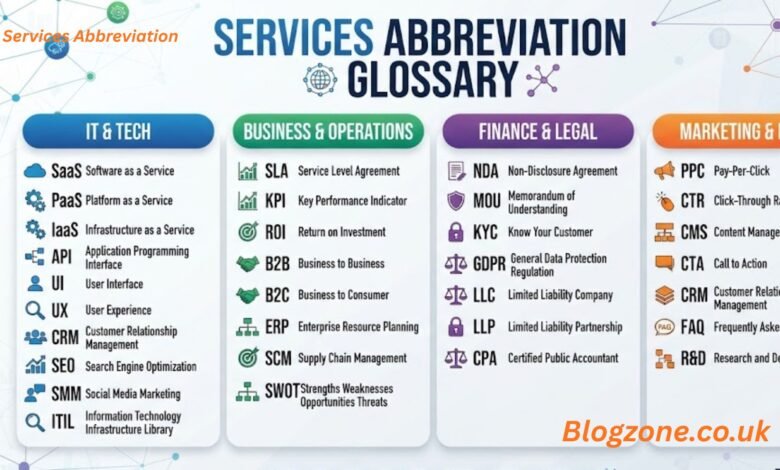
The term services abbreviation refers to the shortened forms of words or phrases commonly used to describe services in business, government, healthcare, education, military, technology, and many other industries. Abbreviations make communication faster, improve document readability, and help organizations maintain consistency across reports, forms, emails, databases, and official documents. Whether you are reading a business proposal, completing government paperwork, working in customer support, or managing corporate records, you will likely encounter numerous service abbreviations every day.
Understanding service abbreviations is important because many industries rely on standardized short forms to avoid repetition while ensuring accuracy. However, abbreviations can sometimes confuse readers if they are used without explanation. Learning their meanings helps professionals communicate more effectively and prevents misunderstandings in formal and informal settings. As businesses continue to adopt digital workflows and global communication, abbreviations have become an essential part of everyday professional language.
What Is a Services Abbreviation?
A services abbreviation is a shortened version of a word or phrase related to a service, department, function, or organization. Instead of writing lengthy service names repeatedly, professionals use abbreviations to save time and space.
For example, customer service, emergency services, financial services, technical services, and administrative services often appear in abbreviated form within reports, contracts, software systems, invoices, and internal communications. These abbreviations simplify documentation while maintaining clarity for people familiar with the terminology.
Most abbreviations are created using the first letters of multiple words, while others may shorten a single word into a commonly accepted format. Their purpose is to improve efficiency without changing the intended meaning.
Why Service Abbreviations Matter
Modern organizations process thousands of documents every day. Writing complete service names repeatedly would increase document length and reduce efficiency. Abbreviations solve this challenge by making communication quicker while maintaining consistency.
Businesses use abbreviations in project management software, customer support tickets, accounting systems, employee records, logistics, healthcare documentation, legal agreements, and educational materials. Employees become familiar with these short forms over time, allowing them to read and prepare documents more efficiently.
Another important benefit is standardization. When everyone uses the same abbreviation, communication becomes more consistent across departments and locations. This reduces confusion and helps organizations maintain professional documentation standards.
Common Business Service Abbreviations
Business environments include many abbreviations that employees encounter daily. Some of the most recognized examples include:
- CS – Customer Service
- HR – Human Resources
- IT – Information Technology
- PR – Public Relations
- QA – Quality Assurance
- CRM – Customer Relationship Management
- ERP – Enterprise Resource Planning
- SOP – Standard Operating Procedure
- KPI – Key Performance Indicator
- BPO – Business Process Outsourcing
These abbreviations appear in emails, presentations, corporate reports, training manuals, and software platforms. Professionals working in offices quickly become familiar with these terms because they simplify routine communication.
Customer Service Abbreviations
Customer support departments rely heavily on abbreviations to improve efficiency when responding to customer inquiries.
Some widely recognized customer service abbreviations include:
- CSR – Customer Service Representative
- CSAT – Customer Satisfaction
- SLA – Service Level Agreement
- FAQ – Frequently Asked Questions
- TAT – Turnaround Time
- FCR – First Call Resolution
- NPS – Net Promoter Score
- IVR – Interactive Voice Response
These abbreviations help customer support teams measure performance, document interactions, and communicate internally without repeatedly writing lengthy phrases.
Government Service Abbreviations
Government agencies also use standardized abbreviations in official documentation. Citizens often encounter these abbreviations when applying for permits, licenses, taxes, social programs, or administrative services.
Examples include:
- DMV – Department of Motor Vehicles
- SSA – Social Security Administration
- IRS – Internal Revenue Service
- EMS – Emergency Medical Services
- USPS – United States Postal Service
- FEMA – Federal Emergency Management Agency
Although different countries use different abbreviations, the purpose remains the same: simplifying official communication while maintaining consistency across departments.
Healthcare Service Abbreviations
Healthcare professionals rely on abbreviations every day because medical documentation requires speed and precision.
Common healthcare service abbreviations include:
- EMS – Emergency Medical Services
- ICU – Intensive Care Unit
- OPD – Outpatient Department
- ER – Emergency Room
- CPR – Cardiopulmonary Resuscitation
- EMT – Emergency Medical Technician
- NHS – National Health Service
- EHR – Electronic Health Record
Medical abbreviations save valuable time during patient care while helping professionals document treatment efficiently. However, healthcare providers must use approved abbreviations carefully to avoid medical errors.
Technology Service Abbreviations
Technology companies frequently use abbreviations to describe digital services, software, cloud computing, and technical support.
Popular examples include:
- SaaS – Software as a Service
- PaaS – Platform as a Service
- IaaS – Infrastructure as a Service
- API – Application Programming Interface
- VPN – Virtual Private Network
- ISP – Internet Service Provider
- DNS – Domain Name System
- MSP – Managed Service Provider
These abbreviations have become standard terminology across the technology industry and are widely recognized by IT professionals worldwide.
Financial Service Abbreviations
Financial institutions also depend on abbreviations for banking, accounting, and investment services.
Frequently used examples include:
- ATM – Automated Teller Machine
- EFT – Electronic Funds Transfer
- ACH – Automated Clearing House
- POS – Point of Sale
- ROI – Return on Investment
- APR – Annual Percentage Rate
- GST – Goods and Services Tax
- VAT – Value Added Tax
These abbreviations simplify financial reports, banking systems, accounting records, and business transactions.
Military Service Abbreviations
Military organizations have developed thousands of abbreviations to support efficient communication during operations and administrative work.
Common military examples include:
- USAF – United States Air Force
- USN – United States Navy
- USMC – United States Marine Corps
- AWOL – Absent Without Official Leave
- CO – Commanding Officer
- HQ – Headquarters
- MIA – Missing in Action
- POW – Prisoner of War
Military abbreviations allow personnel to communicate quickly while reducing lengthy written instructions.
Educational Service Abbreviations
Schools, colleges, and universities also rely on abbreviations in administrative and academic communication.
Examples include:
- GPA – Grade Point Average
- LMS – Learning Management System
- PTA – Parent Teacher Association
- ESL – English as a Second Language
- STEM – Science, Technology, Engineering, and Mathematics
- PDF – Portable Document Format
- ICT – Information and Communication Technology
Educational institutions use these abbreviations in reports, learning platforms, student records, and classroom materials.
Benefits of Using Services Abbreviations
Using abbreviations correctly provides many advantages for organizations and professionals.
One major benefit is faster communication. Employees can write and read documents more efficiently without repeating long service names.
Another benefit is improved document organization. Reports become shorter, cleaner, and easier to scan.
Abbreviations also improve consistency across departments. When standardized terminology is used throughout an organization, everyone understands the same concepts.
Digital systems also benefit because abbreviated terms require less storage space in databases, spreadsheets, and reporting software.
Finally, abbreviations support international business by providing standardized terminology recognized across many industries.
Challenges of Service Abbreviations
Despite their usefulness, abbreviations can sometimes create confusion.
The same abbreviation may have different meanings in different industries. For example, “CS” may represent Customer Service, Computer Science, Civil Service, or Company Secretary depending on the context.
New employees or international partners may not recognize internal abbreviations immediately. Organizations should therefore define abbreviations when they first appear in important documents.
Another challenge involves excessive abbreviation use. Documents filled with unfamiliar abbreviations become difficult to understand, reducing communication quality instead of improving it.
The best practice is balancing efficiency with clarity.
Best Practices for Using Services Abbreviations
Professional communication should follow several simple guidelines when using abbreviations.
Always introduce the complete term before using its abbreviation. For example, write “Customer Relationship Management (CRM)” the first time it appears.
Use only widely recognized abbreviations whenever possible.
Avoid creating unnecessary internal abbreviations unless everyone understands them.
Maintain consistency throughout reports and documents by using the same abbreviation every time.
Consider your audience. Technical experts may understand specialized abbreviations, while customers may require full explanations.
Review documents carefully to ensure abbreviations are accurate and appropriate for the intended readers.
Services Abbreviations in the Digital Age
Digital transformation has increased the importance of abbreviations more than ever before. Businesses communicate through email, messaging platforms, cloud software, mobile applications, and project management systems where concise communication improves productivity.
Artificial intelligence, automation, and cloud computing have introduced new abbreviations almost every year. As industries evolve, professionals continuously learn updated terminology to remain effective in their careers.
Search engines, software interfaces, mobile applications, and online customer portals also favor concise labels, making abbreviations an essential part of modern digital experiences.
How to Learn Common Service Abbreviations
The easiest way to learn abbreviations is through regular exposure. Reading professional documents, industry publications, business reports, and official manuals helps individuals recognize common abbreviations naturally.
Many organizations also publish internal glossaries explaining company-specific terminology. Training programs, onboarding materials, and employee handbooks often include abbreviation lists for new staff members.
Professionals should also pay attention to industry standards because some abbreviations have internationally accepted meanings while others vary by country or organization.
Conclusion
A services abbreviation is much more than a simple shortcut in writing. It represents an important communication tool that helps businesses, healthcare providers, government agencies, educational institutions, financial organizations, and technology companies exchange information efficiently and consistently. From customer service and healthcare to cloud computing and military operations, abbreviations have become part of everyday professional language.
Using abbreviations correctly improves productivity, reduces repetitive writing, and creates standardized documentation that is easier to read and manage. At the same time, professionals should always consider their audience, explain unfamiliar abbreviations when necessary, and maintain consistency throughout their communication. As workplaces become increasingly digital and interconnected, understanding common service abbreviations will remain a valuable skill for students, employees, managers, and business leaders alike.
Also Read