Fascisterne What the Word Means and Why the History Still Matters
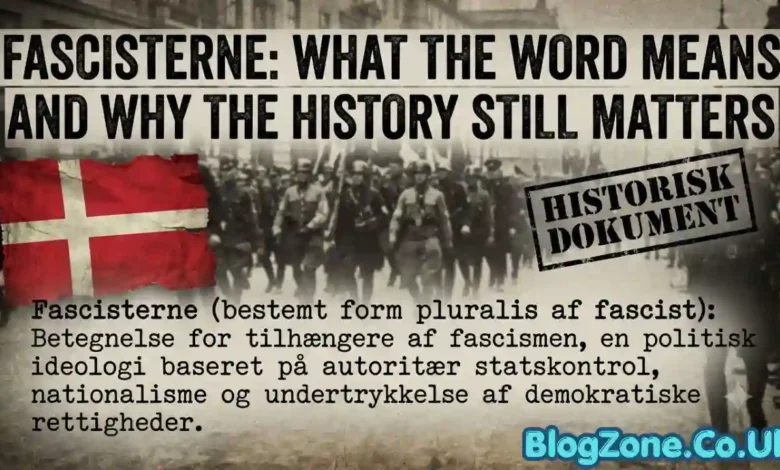
Some words carry more weight than their letter count suggests. Fascisterne is one of them. In Danish, it simply means “the fascists” — yet behind that plain translation sits one of the most turbulent chapters in modern European history. This article breaks down what the word means, where it comes from, how it applies to Denmark specifically, and why people still reach for it today.
What Does “Fascisterne” Mean?
At its core, fascisterne is the definite plural form of the Danish word fascist, which itself derives from fascisme — the Danish spelling of fascism. Put simply, when someone uses fascisterne, they’re referring to “the fascists” as a defined group, rather than fascists in a general or abstract sense.
Danish dictionaries describe fascism as a political ideology that places the state and the collective above the individual, often relying on authoritarian control to override democratic processes. A fascist, then, is someone who supports or actively takes part in that kind of movement. Fascisterne extends that definition to a group — a party, a faction, or a historical bloc identified by their fascist beliefs or actions.
It’s worth noting that the word isn’t only used in strict historical writing. In everyday Danish political conversation, fascisterne sometimes gets thrown around more loosely, as a heated insult aimed at opponents rather than a precise label. That looser usage can blur the line between historical accuracy and rhetorical exaggeration, so context always matters when interpreting the term.
The Origins of Fascism in Europe
To understand fascisterne, it helps to step back and look at where fascism itself came from. The movement took root in Italy in the years following World War I, a period marked by economic hardship, political instability, and widespread disillusionment with existing governments.
Benito Mussolini capitalized on that unrest, founding the Fasci di Combattimento in 1919 — a nationalist paramilitary group that drew veterans, disaffected workers, and those hungry for a strong, centralized authority. By 1922, Mussolini had maneuvered his way into power, and Italy became the first nation to operate under an explicitly fascist government.
The ideology didn’t stay contained to Italy for long. Throughout the 1920s and 1930s, similar movements sprang up across Europe, each shaped by local grievances but united by common threads: intense nationalism, hostility toward liberal democracy, and a belief in a single strong leader who could restore order and national pride. Germany’s National Socialist movement under Adolf Hitler is the most well-documented example, but smaller fascist and fascist-adjacent parties also emerged in Spain, Hungary, Romania, and — relevant to this discussion — Denmark.
Fascisterne in Denmark: The Danish Context
Denmark’s own experience with fascism is central to understanding why the word fascisterne carries such specific historical resonance in Danish. During the 1930s, Denmark had its own homegrown fascist party, Danmarks Nationalsocialistiske Arbejderparti (DNSAP), led by Frits Clausen. The party never gained significant electoral traction on its own, but its presence mattered more once Germany invaded Denmark in April 1940.
Under the German occupation, which lasted until Denmark’s liberation in May 1945, the term fascisterne took on immediate, lived meaning for ordinary Danes. It wasn’t an abstract historical label — it referred to the occupying forces, collaborating officials, and homegrown sympathizers who supported the occupation or actively worked with it. Danish resistance groups, in contrast, organized underground efforts to sabotage German operations, smuggle intelligence, and — notably — help evacuate the vast majority of Denmark’s Jewish population to safety in neutral Sweden in October 1943, one of the most well-documented rescue operations of the war.
So when Danes of that generation spoke of fascisterne, they were often speaking from direct experience of occupation, rationing, curfews, and resistance — not from a history textbook.
Core Traits of Fascist Ideology
Regardless of the country, fascist movements tend to share a recognizable set of characteristics. Understanding these traits helps explain why fascisterne, as a label, gets applied the way it does:
- Ultranationalism — an intense, often exclusionary sense of national identity, frequently tied to ideas of racial or cultural purity
- Authoritarian leadership — concentration of power in a single leader or tightly controlled party structure, with minimal checks on authority
- Suppression of dissent — censorship, imprisonment, or violence directed at political opponents, journalists, and critics
- Propaganda and myth-making — heavy use of media, symbolism, and public spectacle to build loyalty and manufacture consent
- Scapegoating — blaming minority groups or perceived outsiders for a nation’s problems, often used to justify persecution
These traits weren’t unique to any single country. They appeared, with local variations, wherever fascist movements gained ground — which is part of why the word fascisterne can be applied not just to Italy or Germany’s regimes, but to any group in any country that fits this pattern.
Legacy and Aftermath
The defeat of the Axis powers in 1945 brought a reckoning across Europe. Fascist governments collapsed, and many countries — Denmark included — moved to prosecute collaborators and dismantle fascist party structures. Frits Clausen and other DNSAP figures faced legal consequences after the war, and Denmark, like much of Western Europe, spent the following decades processing what occupation and collaboration had meant for its national identity.
This period of reckoning wasn’t just legal — it was cultural. Museums, memorials, school curricula, and public commemorations across Denmark and Europe more broadly were shaped by a shared commitment to ensuring the mechanisms behind fascisterne‘s rise wouldn’t be forgotten or repeated.
Why the Term Still Matters Today
Fascism as a governing ideology may belong to the history books, but the word fascisterne hasn’t disappeared from modern vocabulary. It resurfaces in political debate, often used to describe modern authoritarian movements, far-right nationalist parties, or leaders accused of eroding democratic norms.
This is where care becomes important. Historians and political commentators generally agree that the term carries real analytical weight when applied precisely — to movements or actions that genuinely mirror historical fascism’s core traits. Used carelessly, though, it risks becoming little more than a rhetorical weapon, stripped of its historical specificity.
That tension is exactly why understanding the roots of fascisterne matters. Knowing where the word comes from, and what it actually describes, helps separate serious political analysis from empty insult — and keeps the lessons of that history usable rather than diluted.
FAQ
What language is “fascisterne”?
It’s Danish, and it’s the definite plural form of “fascist” — meaning “the fascists.”
Is “fascisterne” the same as “nazisterne”?
Not exactly. Nazisterne refers specifically to Nazis (National Socialists), a particular strain of fascism tied to Germany. Fascisterne is the broader term, covering fascist movements generally, including but not limited to Nazism.
Was there a fascist government in Denmark?
Denmark didn’t have a fascist government in the way Italy or Germany did. It had a domestic fascist party (DNSAP) with limited influence, and it was occupied by Nazi Germany from 1940 to 1945.
How is the word used today?
Mostly in political commentary and historical discussion, referring either to historical fascist movements or, more loosely, to modern groups accused of authoritarian or extremist tendencies.
Closing Thoughts
Fascisterne is a small word carrying an enormous amount of history. From its roots in early-20th-century Italy to its very real presence in occupied Denmark, the term reflects a period when political ideology reshaped nations, displaced millions, and tested the limits of resistance and courage. Understanding what it means — and where it came from — isn’t just an exercise in language. It’s a way of keeping that history, and its warnings, close at hand.
Also Read: Robert Kagan: Biography, Career, Political Views, and Global Influence